

The Crucial Role of a Leader’s Mind – Part 4
Part 4: Integrating Leadership Wellbeing into Psychosocial Health Approaches
When well-intentioned regulation creates unintended consequences — and what a genuinely effective approach actually looks like
You could be forgiven for thinking that all the noise about psychosocial health regulations over the past few years would have produced a clear roadmap for organisations, leaders, and their employees. And yet, here we are.
Contemporary workplace health and safety standards are necessary and well-intentioned in their aim to improve employees’ wellbeing. No argument there. They are also legally well-constructed and broadly objective on paper. But it’s their implementation that’s the issue — one that has triggered an avalanche of unintended consequences playing out in executive coaching engagements, psychologists’ rooms, and even psychiatric hospitals over the past several months.
The unintended consequences for leaders
Beyond the added administrative, resource, risk, and compliance pressures on employers and regulators, several troubling patterns have emerged — patterns that are showing up repeatedly in clinical and coaching contexts right now.
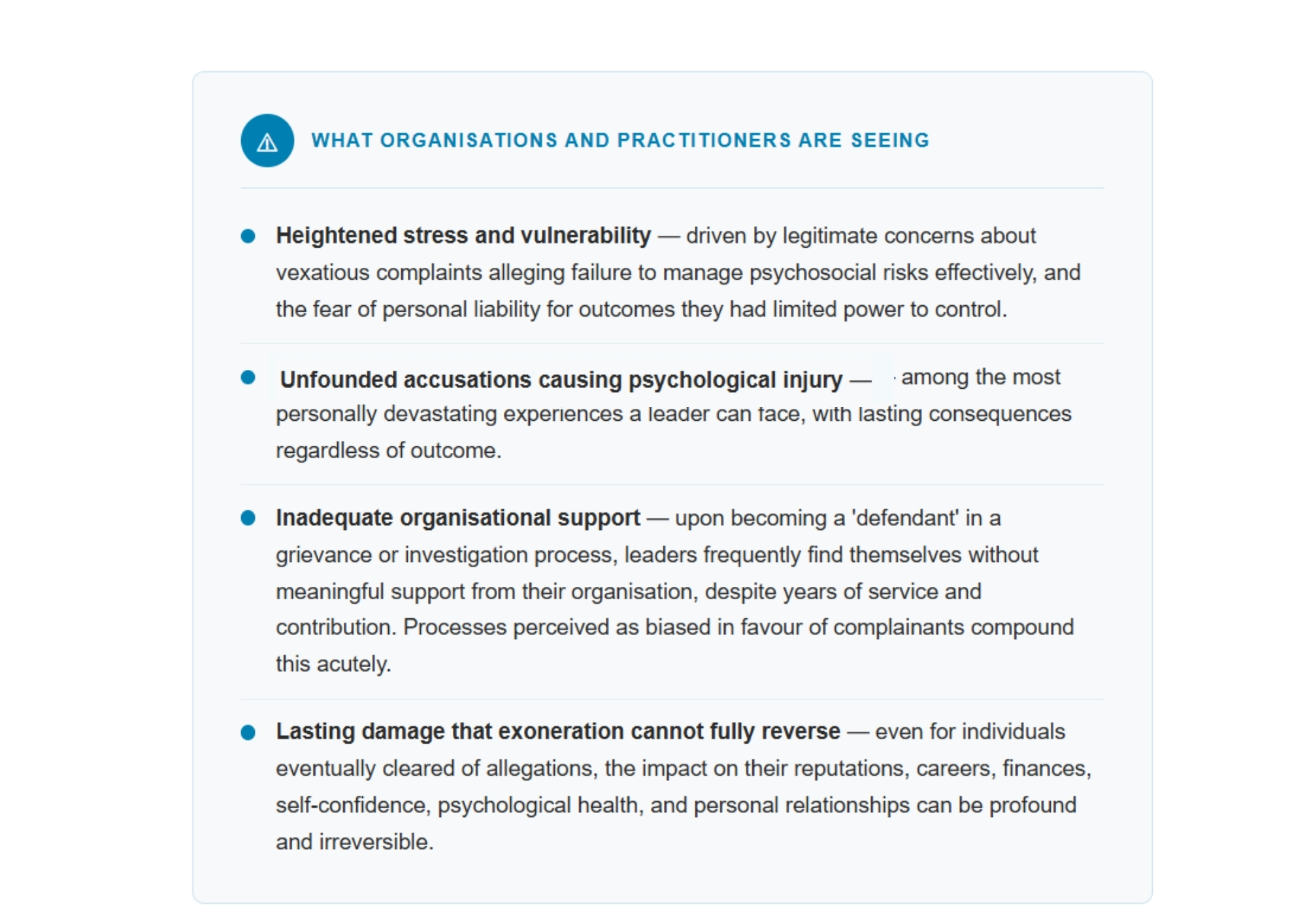
Many of us — myself included — are questioning the ethics of holding leaders legally responsible for the psychosocial health outcomes of their staff, when even those in the most senior roles may have limited autonomy or agency to influence, let alone control, the broader system of organisational and work-related demands that determine employees' psychosocial health.
For leaders already navigating anxiety, stress, uncertainty, or inadequate organisational support, these added pressures don’t just create stress — they actively compromise their own psychological wellbeing. Could it be reasonably argued that the psychosocial factors within these leaders’ work environments are harming their mental health, or that prolonged exposure to such conditions has caused or exacerbated psychological injury? Well, you don’t have to be a lawyer to answer that.
The systems problem at the heart of PSH implementation
Organisational science consistently shows that when complex problems are oversimplified, organisations overlook the interconnections within their systems. This blind spot prevents them from recognising the crucial links and feedback loops necessary for sustainable, effective change. Organisational psychologists, executive coaches, and OD professionals are increasingly concerned by the neglect of systemic dynamics at play — and the failure to adopt a genuinely holistic perspective on psychosocial health.
By adopting a systems-based approach, organisations can address root causes rather than treating symptoms. This is what leads to comprehensive and lasting improvement.
Ensuring employees are protected from psychological injury and supported to stay healthy and high-performing requires the ability to balance multiple factors — many of them shaped by the organisation’s broader environment: its culture, systems, processes, job stressors, resourcing levels, work practices, and interpersonal dynamics. And on top of that, each individual’s unique personal and lifestyle factors come into play.
There is no one-size-fits-all approach to enhancing leadership wellbeing. Leadership wellbeing isn’t just a personal concern for leaders — it profoundly impacts the entire organisation. Leaders who are mentally, emotionally, and physically healthy create psychologically safer work environments and drive better performance across the board.
What a genuinely effective approach looks like
To truly support improved wellbeing, risk management, and performance, organisations need a nuanced approach that can evaluate all of these interacting elements together. It’s about understanding how they work in concert to influence both personal and organisational outcomes. Appreciating the bigger picture — and the interplay of various contributing factors — is key to fostering an environment where leaders and their teams can genuinely thrive.
And the best way to build that understanding?
A sophisticated, accurate assessment of all the demands and resources — and the interplay between them — is the foundation. And that can only be achieved through a valid and reliable measurement instrument.
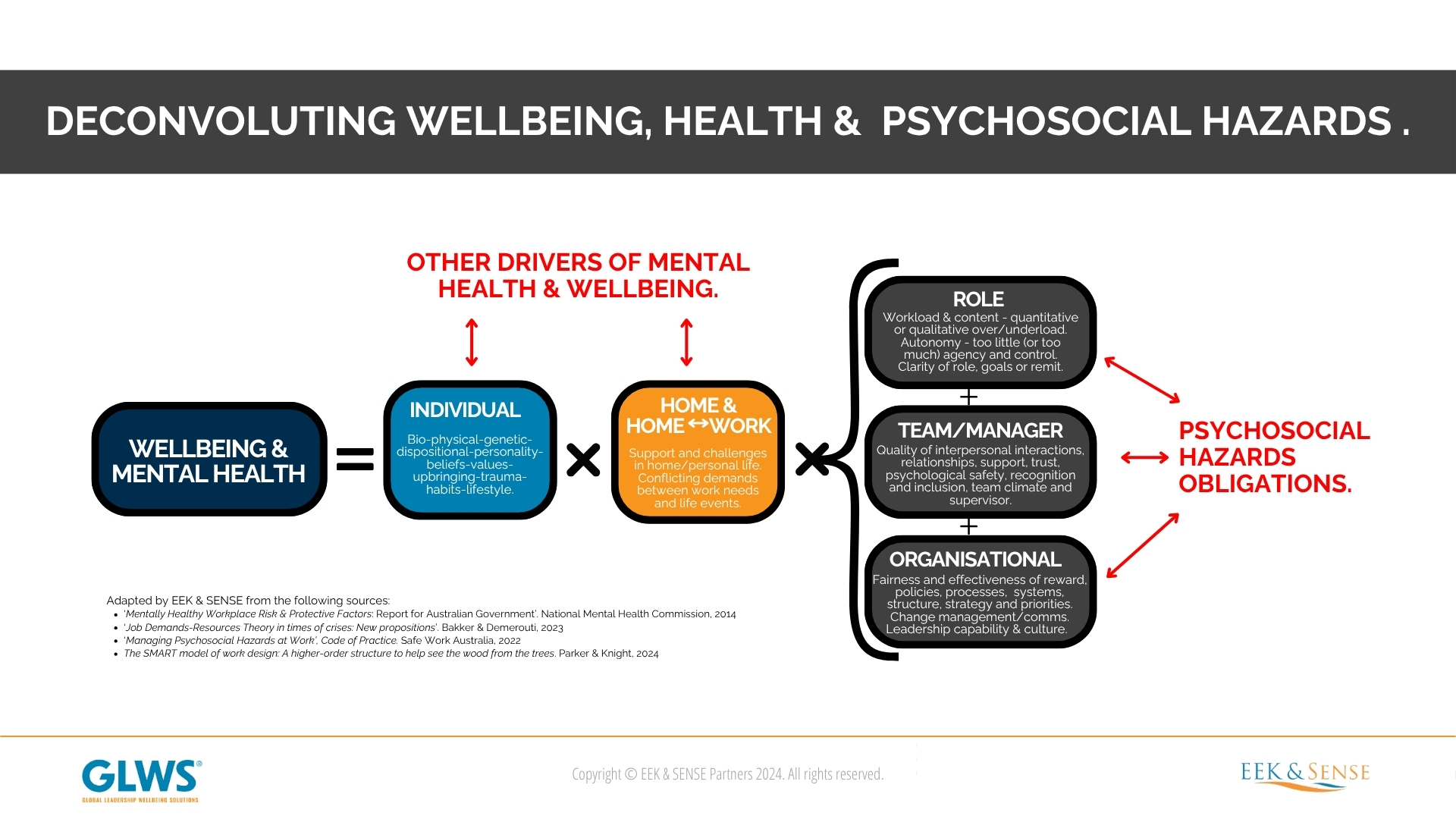
For a download of this image contact: marisa@glwswellbeing.com
This is precisely where the GLWS comes in. The GLWS uniquely addresses all of the dimensions captured in the framework above — because it was designed to do exactly this. It enables organisations to consider and support leaders’ psychosocial health in the full context of their roles and their lives: professional demands, personal circumstances, team dynamics, and organisational culture — all assessed together, all informing a personalised development pathway.
Are you GLWS Accredited? You already have the capability to deliver this.
GLWS accredited practitioners have everything they need to conduct this kind of rigorous, multi-dimensional assessment with their internal teams and clients. If you’re accredited, this is the moment to bring it to the table.
We’ll be back soon with the fifth and final instalment of The Crucial Role of a Leader’s Mind — where we’ll look at how to embed leadership wellbeing directly into organisational strategy and everyday operations.
Until then, do your best to mind your mind — above the line.
Audrey McGibbon
Co-founder & CEO, EEK & SENSE Partners | GLWS Wellbeing
See the GLWS™ in action now with a suite of sample reports
If you are a leader, or a coach working with leaders, you can find out how the GLWS works in practice by reviewing our suite of reports. Sign up here to get instant access.