

The Crucial Role of a Leader’s Mind – Part 3
Part 3: Cultivating skills for thriving high performing leadership with GLWS
Interesting quick fact – did you know 43% of senior professionals and leaders sometimes, usually, or always feel they are under-utilised and have more to offer their organisations? I’m sure our Productivity Commissioner and your CEO would have something to say about that!
That’s not just a wellbeing statistic. That’s a performance problem — and a leadership opportunity hiding in plain sight.
So far in this series, I hope I’ve convinced you that a leader’s mindset forms the foundation of their attitudes, beliefs, and expectations. It influences their decisions, actions, and interactions with their team. When leaders suffer, the business suffers. Leader wellbeing is a critical lever for better business performance. Leaders with a positive and growth-oriented mindset can inspire and motivate their teams, foster a healthy organisational culture, and navigate challenges effectively.
I’ve also been thinking about how organisations can reframe their approach to leadership wellbeing in ways that reflect the true importance of their leaders’ minds as vital assets, placing a focus on learning the skills to ‘mind their minds’ and doing a better job of leveraging their full potential.
So, in Part 3, I wanted to go deeper and explore how we can help leaders to ‘mind their minds’ by providing essential insights into how aspects of their emotional regulation, cognitive focus, interpersonal relationships and other many other skills relate to their wellbeing.
That’s the spirit behind this series. And it brings us to the GLWS® Wellbeing Framework.
The shortest way of describing the GLWS Framework is as a validated multi-dimensional model of the key factors driving and sustaining professionals’ and leaders’ wellbeing, professionally and personally.
For the purposes of this article, I’ve shared a simplified version of the GLWS Framework below, alongside the mind-training skills associated not only with improved wellbeing, but with measurably better performance outcomes — mapped to each of the six dimensions:
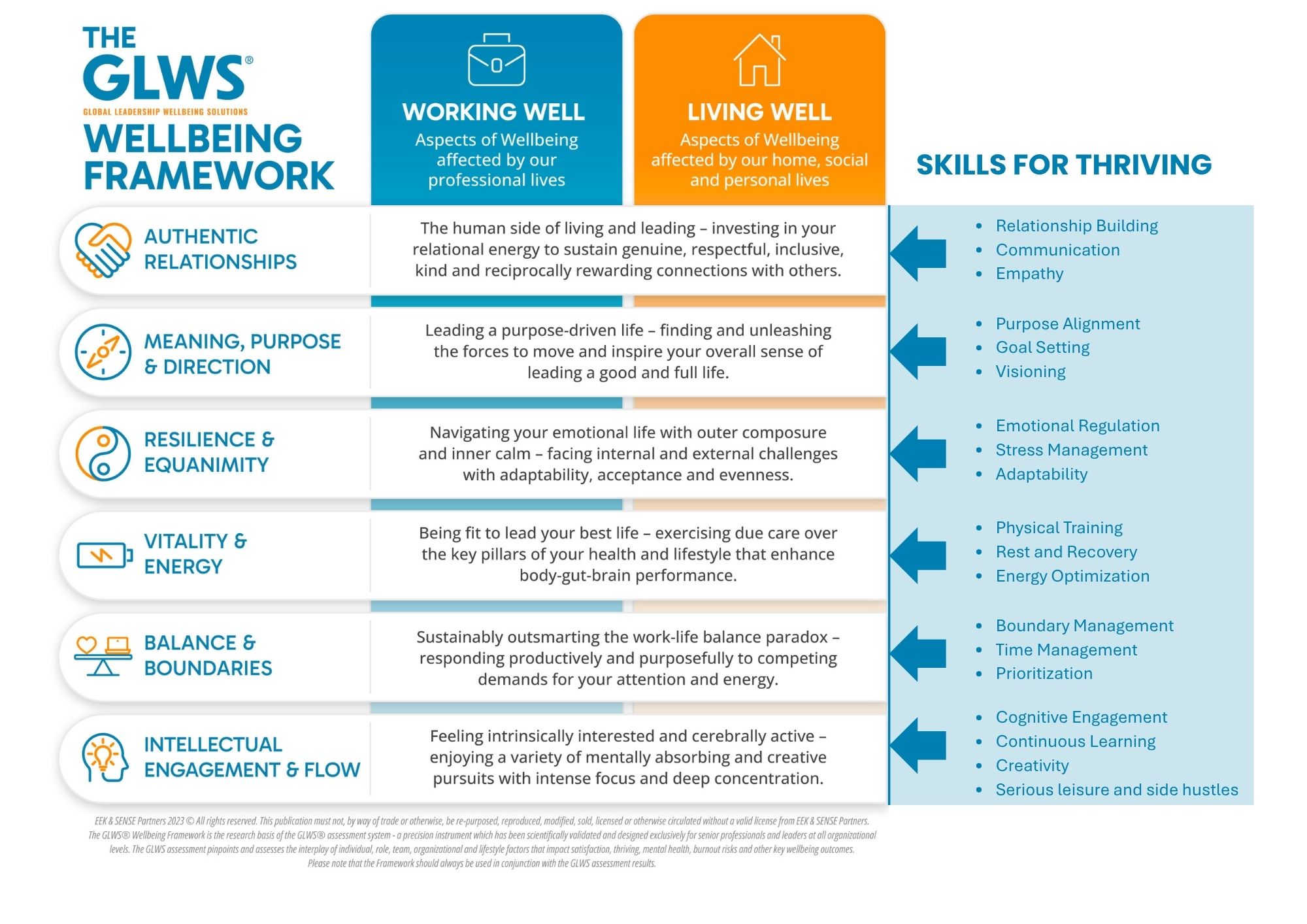
Wellbeing is increasingly recognized as a crucial factor that shapes a leader’s success and overall development. What the GLWS Framework makes visible is this: the skills associated with each wellbeing dimension — emotional regulation, purpose alignment, boundary management, cognitive engagement, and more — are not just desirable for wellbeing. They are catalysts for performance success. When leaders invest in building these skills, the benefits ripple through their teams and organisations.
This is precisely where GLWS is so powerful in the hands of a skilled practitioner. It gives leaders a precise, evidence-based picture of where they stand across each of these dimensions — and a clear, personalised pathway for development that is practical, sustainable, and measurable.
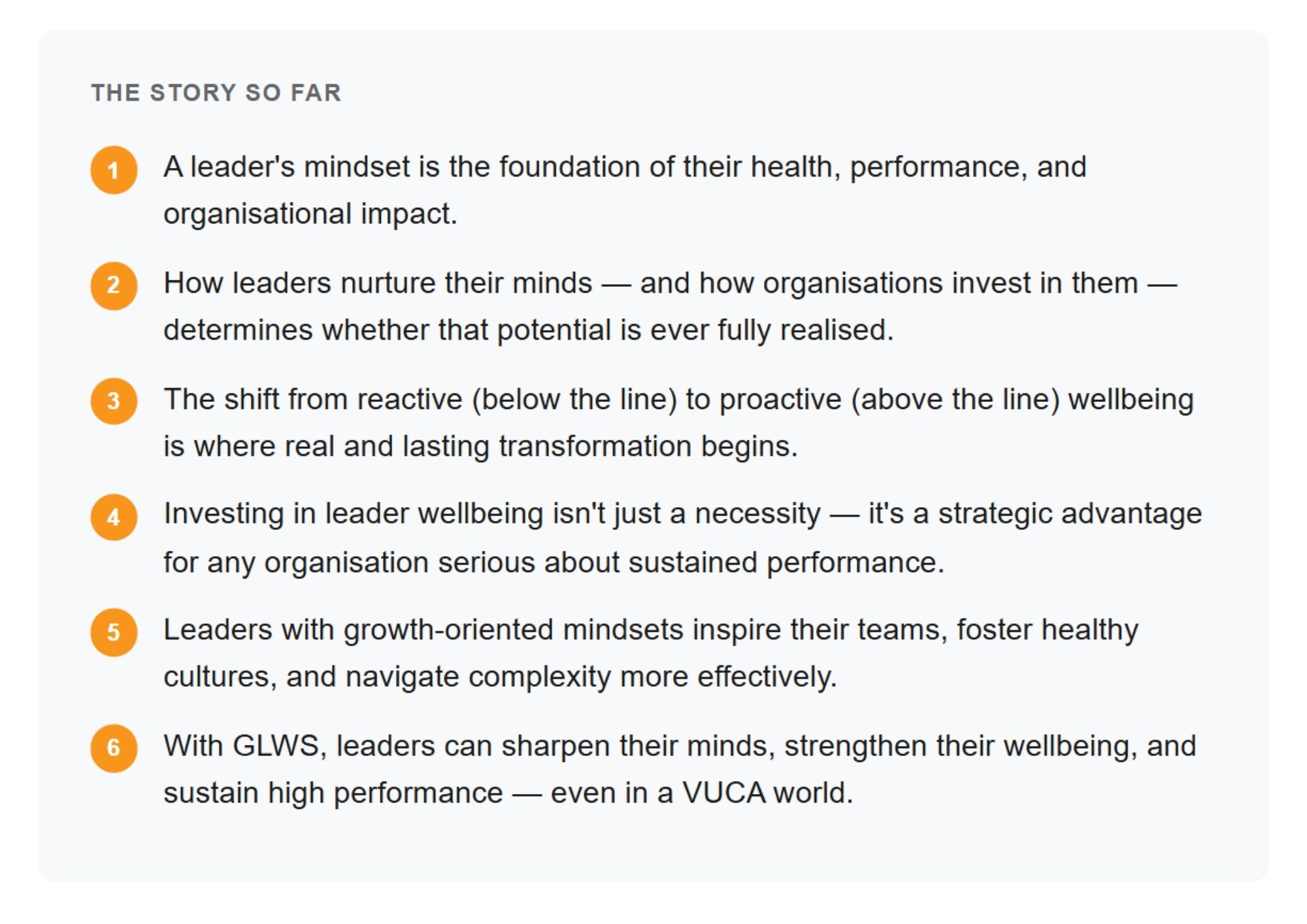
To recap, here’s the full storyline across Parts 1–3 so far:
Now is the time to act.
If you’re working with organisations/leaders who are navigating a VUCA world — and who isn’t — this is the kind of insight that changes conversations.
Stay tuned for more insights coming up in The Crucial Role of a Leader’s Mind Part 4: Integrating ‘Leadership Wellbeing’ into psychosocial health approaches.
See the GLWS™ in action now with a suite of sample reports
If you are a leader, or a coach working with leaders, you can find out how the GLWS works in practice by reviewing our suite of reports. Sign up here to get instant access.