

The Crucial Role of a Leader’s Mind – Part 2
In Part 1 of The Crucial Role of a Leader’s Mind series, I highlighted the importance of focusing on the skills and tools that will help your leaders and senior professionals to more deeply understand and enhance their mindsets, beliefs, psychological needs, and emotions. Such shifts significantly increase the likelihood of them achieving improved and sustainable high performance, as individuals and for the organisation .
Leaders and senior professionals across all sectors are under immense and unrelenting pressure to adapt—so focusing on their mental wellbeing has never been more important.
Executives and decision-makers represent the apex of business and have a critical influence over the industry and/or sector they represent. If individuals are struggling to cope or no longer want to accept decision-making positions because they are too stressful or the role does not include the required support, then that can have significant ramifications for the industry and/or sector…For boards and governing committees, the value proposition is slightly different. Turnover in these roles is disruptive and can negatively impact the organisation’s performance and standing. There may also be legal ramifications for board directors. (Australian Government, National Mental Health Commission (NMHC), 2024)
In Part 2, I’m sharing our adaptation of the conventional VUCA model. Traditionally a problem-focused strategic framework, here it is, reimagined it into a growth-centric and positive performance model to help leaders cultivate the mindsets they need to thrive amidst today’s challenges.
Here’s the reframe — and a conversation starter you can bring directly to your next client engagement:
Part 2: Leadership mindsets for thriving in a dynamic world
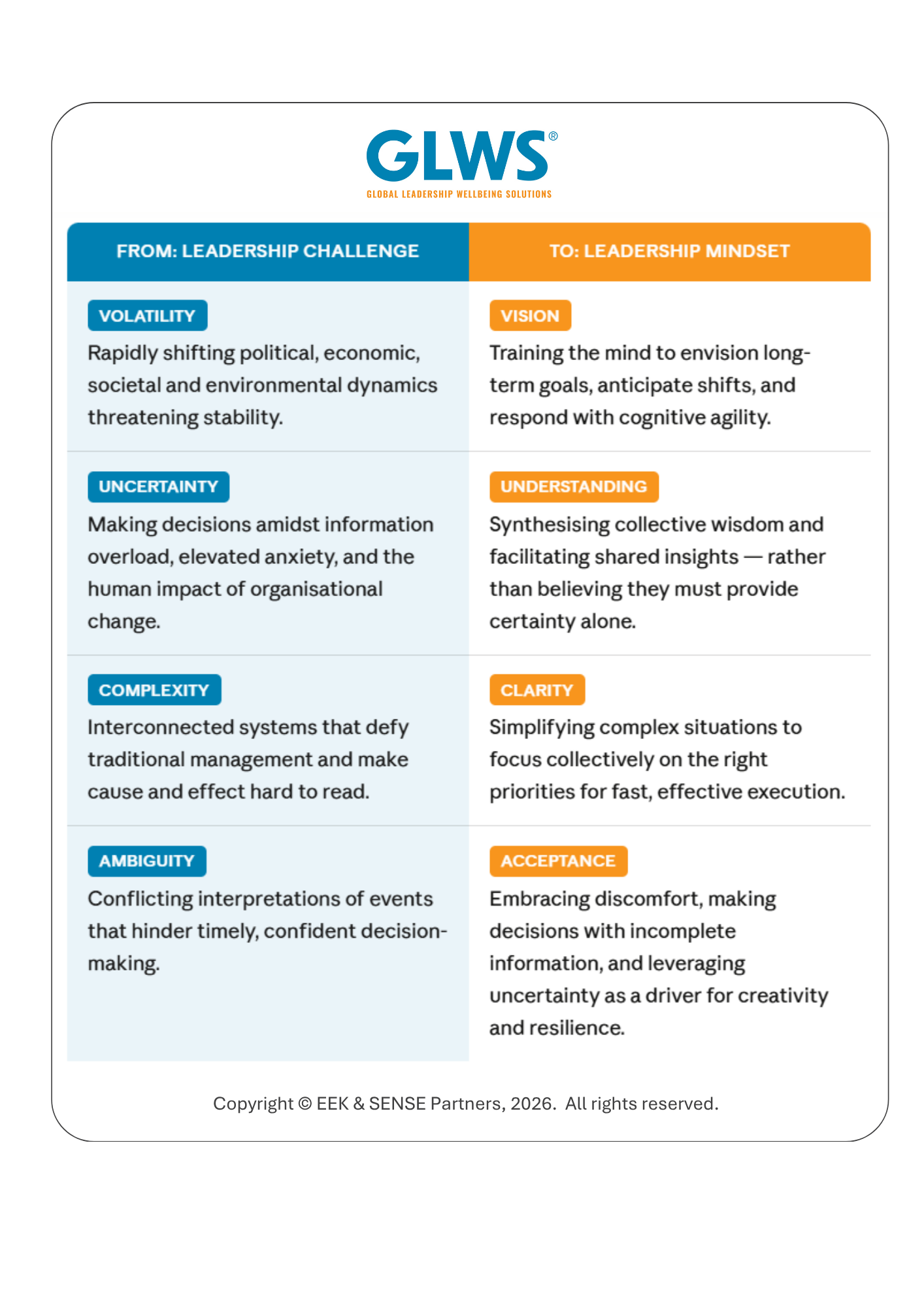
I know many of our clients and delivery partners have found good mileage in framing wellbeing in this way, because these aren’t abstract ideals.
They’re trainable mindsets — and GLWS® is one of the most powerful tools available for helping leaders develop them.
Through structured self-reflection, GLWS surfaces the precise emotional and cognitive patterns that shape how a leader shows up: their resilience, focus, positivity, trust, and capacity to adapt.
If you’re working with organisations navigating a VUCA world — and who isn’t — this is the kind of insight that changes conversations. And GLWS Accredited Practitioners have the skills and credentials to bring this work to their clients.
Stay tuned for more insights coming up in The Crucial Role of a Leader’s Mind Part 3: Cultivating Skills for Thriving Leadership Minds.
See the GLWS™ in action now with a suite of sample reports
If you are a leader, or a coach working with leaders, you can find out how the GLWS works in practice by reviewing our suite of reports. Sign up here to get instant access.